(English version below)
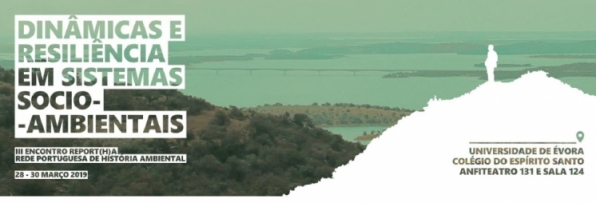
Concluído o III Encontro Report(h)a que decorreu na Universidade de Évora sob o tema agregador "Dinâmica e Resiliência em Sistemas Sócio-ambientais", é altura de vos fazer um breve balanço dos três dias intensos de trabalho rico e estimulante que tivemos graças à vossa participação.
A nossa primeira nota realça o elevado nível de internacionalização deste encontro, com destaque para a participação de grupos de investigação espanhóis e italianos, para além dos portugueses. Assim, foram apresentadas 48 comunicações (58 autores), sendo menos de metade (22) de portugueses. Tivemos 8 comunicações subscritas por investigadores e académicos brasileiros, outras 8 por espanhóis e 8 por italianos. No conjunto, os participantes apresentaram vínculos a 23 centros de investigação e instituições diferentes, com destaque para o CITCEM – Porto, CIDEHUS – Évora, Universidade do Minho, a par de outros centros de universidades brasileiras (PUC – Rio de Janeiro, Rondônia), espanholas (Granada, Alicante, Murcia, Huelva, Extremadura) e da Suécia (KTH). Da parte portuguesa, houve ainda representação do IHC (UN Lisboa), ISCTE, ICS (U Lisboa). O encontro constituiu, por isso, uma oportunidade para reforçar laços pessoais e profissionais entre diferentes grupos de trabalho.
A nossa segunda nota, também muito positiva, prende-se com a participação de jovens investigadores, doutorandos e pós-doutorados, enquadrados em equipas de investigação em história ambiental.
Finalmente, salientemos a diversidade temática das sessões com comunicações que fizeram a ponte entre a história ambiental e os regimes políticos, a construção de novas paisagens no período moderno e contemporâneo, a construção normativa da sustentabilidade ambiental no passado, a história do clima, a legislação ambiental, as pescas, as florestas, as heranças tóxicas, os novos ambientes urbanos, os conflitos ambientais, as questões sanitárias e de saúde associados aos meios industriais, as humanidades ambientais, etc. O livro de resumos que publicámos fica como testemunho.
Embora não esteja prevista a publicação de um livro de actas, refira-se a este respeito que o Cidehus, através da sua linha de publicações, em parceria com a Open Edition Books (
http://books.openedition.org/cidehus) acolhe propostas de edição de livros no âmbito da história ambiental.
A reunião da rede, realizada no dia 29 de Março, garantiu a continuidade dos encontros Report(h)a, sendo o próximo acolhido pela Universidade de Coimbra, em 2021. Um resultado que muito deve ao esforço da Prof.ª Inês Amorim.
Os nossos agradecimentos finais aos membros da Comissão Científica que nos apoiaram na construção deste evento e ao Dr. Marco Armiero, do Laboratório de Humanidades Ambientais do Instituto Real de Tecnologia da Suécia, pela sua disponibilidade e apoio.
Agradecemos, ainda, o apoio do CIDEHUS, da Escola de Ciências Sociais e do CICP, assim como ao Rafael Vasques, Nevena Tatovic e Guilherme Vinicius pelo apoio no secretariado.
A todos vós, que desejamos tenham tido uma boa estadia em Évora e uma boa viagem de regresso, agradecemos o v/ contributo para este encontro da rede.
A comissão organizadora,
Paulo E. Guimarães
Sónia Bombico
Armando Quintas
---------------
At the conclusion of the 3rd Meeting of REPORT(H)A held at the University of Évora under the theme "Dynamics and Resilience in Socio-Environmental Systems", it is time to take stock of the three intense days of rich and stimulating work that we have had to your participation.
Our first note highlights the high level of internationalization of this meeting, especially the participation of Spanish and Italian research groups, in addition to the Portuguese. Thus, 48 communications (58 authors) were presented, with less than half (22) of Portuguese. We had 8 communications subscribed by Brazilian researchers and academics, 8 by Spanish and 8 by Italians. On the whole, the participants presented links to 23 different research centers and institutions, in particular CITCEM - Porto, CIDEHUS - Évora, Universidade do Minho, and other centers of Brazilian universities (PUC - Rio de Janeiro, Rondônia), spanish (Granada, Alicante, Murcia, Huelva, Extremadura) and Sweden (KTH). From the Portuguese side, there was also a representations of the IHC (UN Lisboa), ISCTE, ICS (U Lisboa). The meeting was therefore an opportunity to strengthen personal and professional ties between different working groups.
Our second note, also very positive, is the participation of young researchers, phd students and post-doctorates, framed in research teams in environmental history.
Finally, we highlight the thematic diversity of the sessions with communications that bridged environmental history and political regimes, the construction of new landscapes in the modern and contemporary period, the normative construction of environmental sustainability in the past, climate history, legislation environment, fisheries, forests, toxic heritages, new urban environments, environmental conflicts, health and health issues associated with industrial environments, environmental humanities, etc. The book of abstracts we published is a testimony.
Although the publication of a book is not foreseen, it should be mentioned that the CIDEHUS, through its line of publications, in partnership with Open Edition Books (
https://books.openedition.org/cidehus/) welcomes proposals for book publishing in the context of environmental history.
The meeting of the network, held on March 29, ensured the continuity of the REPORT(H)A a meetings, the next being hosted by the University of Coimbra in 2021. A result that much owes to Prof. Inês Amorim's effort.
Our final thanks to the members of the Scientific Committee who supported us in the construction of this event and to Dr. Marco Armiero of the Laboratory of Environmental Humanities of the Royal Institute of Technology of Sweden for their availability and support.
We are also grateful for the support of CIDEHUS, the School of Social Sciences and CICP, as well as Rafael Vasques, Nevena Tatovic and Guilherme Vinicius for their support at the secretariat.
To all of you, who wish we had a good stay in Évora and a good trip back, we thank you for your contribution to this meeting of the network.
The organizing committee,
Paulo E. Guimarães
Sónia Bombico
Armando Quintas

![[SOLCHA] Call BOHA (Biblioteca Online de Historia Ambiental)](/media/k2/items/cache/91b1b90c684fd8e5c2ec1b7418ca380f_M.jpg)