
News

FB group on Environmental History in Central, Eastern and Southeastern Europe
- Published in News
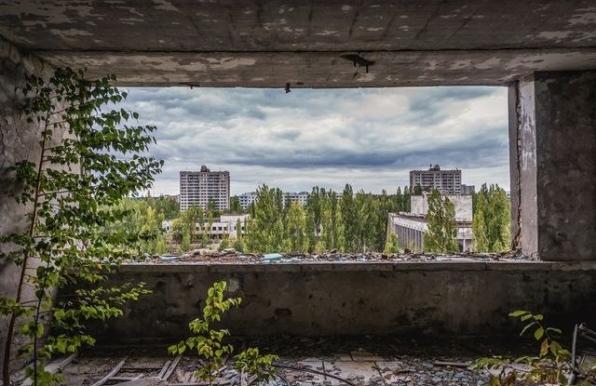
Message from Regional Representative from Czechia and Slovakia Environmental History in Central, Eastern and Southeastern Europe
Dear colleagues, dear regional representatives,
I would like to invite you to join our new FB group on Environmental History in Central, Eastern and Southeastern Europe which was created with the aim to facilitate the exchange of information on EH not only in the region. Especially, I would like to invite regional representatives from respective countries to join the group and share information from their countries. To keep the information exchange is so important these days, thanks in advance for sharing infos from your regions, countries and from your field of expertise.
Link: https://www.facebook.com/groups/267355605051103/
Thanks a lot!
Best wishes,
Doubravka Olsakova
RR Czechia and Slovakia
CfP: 16th International Conference on Interdisciplinary Social Sciences (Oxford Brookes University, UK, 21–23 July 2021)
- Published in News

Founded in 2006, the Interdisciplinary Social Sciences Research Network is brought together by a common interest in disciplinary and interdisciplinary approaches, within and across the various social sciences, and between the social, natural and applied sciences. We seek to build an epistemic community where we can make linkages across disciplinary, geographic, and cultural boundaries. As a Research Network, we are defined by our scope and concerns and motivated to build strategies for action framed by our shared themes and tensions.
The Sixteenth International Conference on Interdisciplinary Social Sciences calls for research addressing the following annual themes and special focus:
THEME 1: SOCIAL AND COMMUNITY STUDIES
THEME 2: CIVIC AND POLITICAL STUDIES
THEME 3: CULTURAL STUDIES
THEME 4: GLOBAL STUDIES
THEME 5: ENVIRONMENTAL STUDIES
THEME 6: ORGANIZATIONAL STUDIES
THEME 7: EDUCATIONAL STUDIES
THEME 8: COMMUNICATION STUDIES
+ info: https://thesocialsciences.com/2021-conference/call-for-papers
ESEH Environmental History Seminar series - PROGRAM
- Published in News
Between March and July ESEH is hosting an on-line seminar series, open to everyone.
Registration for each session via the link in attachment: https://forms.gle/Ui1vvJatVPFMP6Bk7
More info: This email address is being protected from spambots. You need JavaScript enabled to view it. or This email address is being protected from spambots. You need JavaScript enabled to view it.
Those registered will receive a link two days before the seminar
PhD-vacancy (5 years) on history of fishery collectivities at Rotterdam School of Management (EUR)
- Published in News
Vacant PhD-position on the historical analysis of the development of fishing collectivities as Institutions for Collective Action (ICAs). The PhD-student will be joining the interdisciplinary Institutions for Collective Action research team at the Rotterdam School of Management at the Erasmus University for a period of 5 years (full-time, fully funded).
The topic of the PhD-position in a nutshell: In the present day across Europe, new bottom-up and self-governing institutions for the provisioning of energy, food, care and many other goods and services are increasingly being set up by citizens. Citizens hereby govern and use resources collectively according to the rules they decide upon as a group. The institutional design of these modern-day forms of citizen collectivities has many similarities with guilds, commons, cooperatives, and other institutions that have been developed in Europe’s history. The PhD-student will be studying such historical forms of institutions for collective action, and in particular the functioning of fishing collectivities, from the various forms of guilds in the early modern period to cooperatives formed by fishermen today. The relevance of the study of collectivities in fisheries goes far beyond a contribution to explaining what makes ICAs resilient. It also connects to highly relevant societal debates about -amongst others- the current challenges of the fishing industry (both legal, as in the fishing quota, and in social-economic sense), sustainability, and globalisation.
Read more about the position via this link! Apply using the same website. Do note that the application deadline is April 20th, 2021. PhD-students will start in September 2021. Supervisor: Prof. Dr. Tine De Moor. Questions concerning the position can be send to This email address is being protected from spambots. You need JavaScript enabled to view it..
Call for Applications: International Doctoral Program "Rethinking Environment" University of Augsburg and RCC
- Published in News

The graduate program offers 12 funded PhD positions (TVL-13, 65% for 3 years) in the environmental humanities and we would be very grateful if you could share this attached call with anyone who might be interested. On the program's website, applicants can read up on the thematic structure of the program and get inspired by potential topics to explore. We very much encourage interdisciplinary proposals as doctoral students will be supervised by an interdisciplinary team of scholars from both Augsburg and Munich. The program also offers a selected number of affiliate positions for PhD students who come with their own funding, but also want to become part of this program. Application deadline is 15 April 2021. The program starts October 1.
If you have any questions on the application process, please reach out to PD Dr. Kirsten Twelbeck (This email address is being protected from spambots. You need JavaScript enabled to view it.) or Dr. Hanna Straß-Senol (This email address is being protected from spambots. You need JavaScript enabled to view it.)
+ info: https://www.carsoncenter.uni-muenchen.de/graduate_programms/idk/applications/index.html
New Book: The History of Water Management in the Iberian Peninsula: Between the 16th and 19th centuries
- Published in News
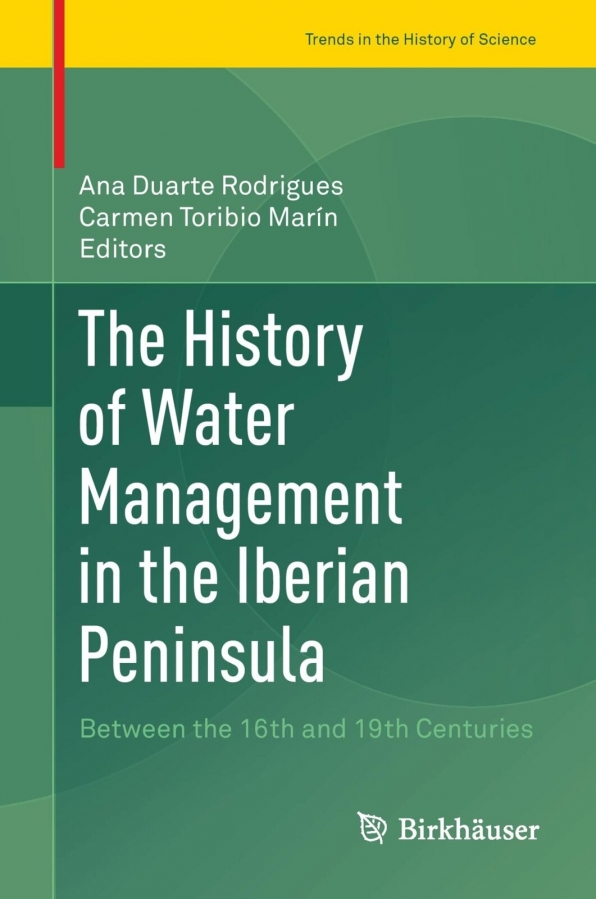
Autoria: Ana Duarte Rodrigues e Carmen Toribio (eds.)
Edição Springer, Ano 2020, ISBN 978-3-030-34060-5
This volume approaches the history of water in the Iberian Peninsula in a novel way, by linking it to the ongoing international debate on water crisis and solutions to overcome the lack of water in the Mediterranean. What water devices were found? What were the models for these devices? How were they distributed in the villas and monastic enclosures? What impact did hydraulic theoretical knowledge have on these water systems, and how could these systems impact on hydraulic technology? Guided by these questions, this book covers the history of water in the most significant cities, the role of water in landscape transformation, the irrigation systems and water devices in gardens and villas, and, lastly, the theoretical and educational background on water management and hydraulics in the Iberian Peninsula between the sixteenth and the nineteenth centuries. Historiography on water management in the territory that is today Spain has highlighted the region’s role as a mediator between the Islamic masters of water and the Christian world. The history of water in Portugal is less known, and it has been taken for granted that is similar to its neighbour. This book compares two countries that have the same historical roots and, therefore, many similar stories, but at the same time, offers insights into particular aspects of each country.
New book: «Como a Fénix renascida. Matas, bosques e arvoredos (séculos XVI-XX): representações, gestão, fruição» by Cristina Joanaz de Melo (Coord.)
- Published in News
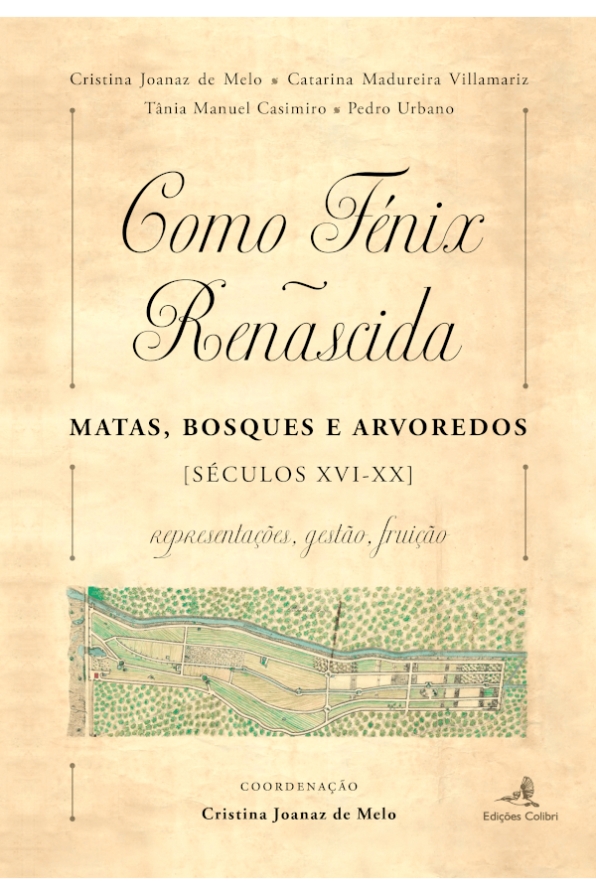
«Como a Fénix renascida. Matas, bosques e arvoredos (séculos XVI-XX): representações, gestão, fruição»
- Cristina Joanaz de Melo (Coord.)
- 2020
- Lisboa: Edições Colibri
- ISBN: 978-989-689-946-2
- Depósito legal n.º 465 468/19
- Idioma: Português
- 186 p.
Resumo
No decurso da história, a floresta gerou conceções e representações espirituais e artísticas, permitiu utilizações económicas e sociais e adquiriu funções utilitárias e lúdicas. Atravessando diferentes períodos e contextos, o presente livro pretende refletir sobre temas inovadores que vão da representação à gestão e fruição da floresta. A narrativa, intencionalmente poliédrica, explora as representações de florestas, matas e arvoredos no vitral de produção nacional da época medieval e moderna, bem como na faiança dos séculos XVI a XVIII. Paralelamente, analisa-se a exploração e regeneração de recursos florestais, considerando a gestão territorial, respetivo ordenamento e fruição de elemento naturais do final da Idade Média ao século XIX. E, por fim, aborda-se a relação que se estabelece entre caçadas e tapadas régias nos finais da monarquia constitucional.
Intencionalmente, procurou-se trabalhar períodos cronológicos anteriores aos grandes flagelos ecológicos despoletados por guerras mundiais e pelo boom demográfico mundial do século XX, a partir do qual a relação com a floresta mudou exponencialmente. Atualmente, num paradigma de reflexão ecológico-ambiental, considera-se que o património florestal mundial se encontra em risco e, em consequência dessa realidade insofismável, em risco também a vida do planeta, tal como a conhecemos. Com esta obra, para além de trazer para a luz questões até aqui deixadas na sombra, apostando numa abordagem inovadora em torno da temática da floresta, procurou-se também valorizar a mesma e relembrar o lugar de destaque que ocupou ao longo dos séculos e que se espera que o século XXI lhe venha a devolver.